
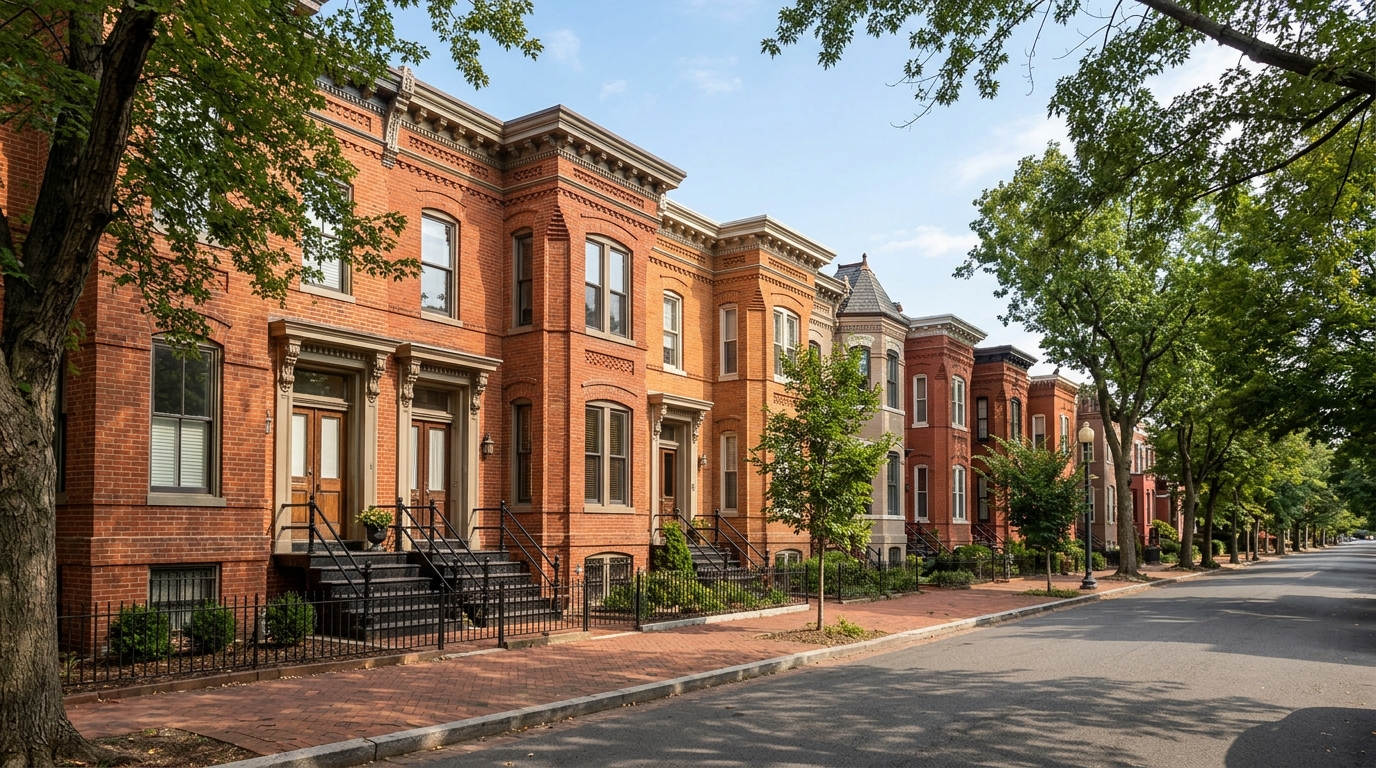
Capitol Hill is Washington's largest residential historic district, a roughly 300-acre neighborhood of brick row houses centered on the U.S. Capitol, where daily life runs on walkability, Eastern Market, and a preservation review process that shapes almost every exterior decision an owner makes. For a home buyer, that translates to a specific trade: you get architectural coherence, mature streetscapes, and short walks to work and errands, but you accept that changing a window, a door, or a roofline on most properties means clearing historic approval first. If you are weighing the move, the first thing to confirm is whether the exact address sits inside the Capitol Hill Historic District boundary, because that single fact drives your renovation timeline and your budget.
Short Answer
The neighborhood spans roughly 300 acres around the Capitol, the Supreme Court, and the Library of Congress, and its commercial life centers on Pennsylvania Avenue SE and Eastern Market, the public market on 7th Street SE operating since 1873.
For buyers, the decision usually comes down to three things:
- Housing type. Capitol Hill has 5,767 row houses, and attached historic homes define much of its housing stock.
- Historic review. Any exterior change on a contributing property typically requires a Certificate of Appropriateness from the DC Historic Preservation Review Board, which affects windows, doors, roofing, and facade materials.
- Walkability. The Capitol complex and Eastern Market are major neighborhood anchors, so compare the actual walking route from any home you are considering.
The first verification step is straightforward: check the property's address against the Capitol Hill Historic District boundary and confirm which Advisory Neighborhood Commission district it falls in, because both determine what you can and cannot do to the house.
What Buyers Should Know About Life and Housing in Capitol Hill
Capitol Hill has 5,767 row houses and the fundamentals of a neighborhood built out, historically protected, and in consistent demand, and each of those traits shapes what buying here feels like. It is the largest residential historic district in DC, spanning roughly 300 acres centered on the Capitol itself.
Federal brick row houses dating to the early 1800s define much of the district and give streets around Eastern Market their historic character. If you want a detached house with a wide side yard, compare the specific inventory carefully. If you want an attached historic home with original detail and a walkable front stoop, Capitol Hill offers many examples to evaluate.
A historic district is a legally defined area where exterior alterations to contributing buildings are subject to design review; it is not merely an honorary label. In practical terms, that means replacing wood windows with vinyl, swapping an entry door, re-roofing with a visible material change, or altering the front facade will typically route through the Historic Preservation Office and the Review Board before you can pull a permit.
Walkability is the everyday payoff. Capitol Hill sits near the U.S. Congress, the Supreme Court, and the Library of Congress, while Pennsylvania Avenue SE and Eastern Market on 7th Street SE anchor much of its commercial life. Eastern Market has operated as a public market since 1873. From any home you are considering, check the real walking routes to the errands and destinations you expect to use most.
The neighborhood is organized into Advisory Neighborhood Commissions. An ANC is an elected, non-partisan local body that advises the DC government on issues like zoning, liquor licenses, and historic matters affecting its area. ANC 6B represents an area bounded roughly by the US Capitol to the west, 15th Street SE and the Anacostia to the east, East Capitol Street to the north, and the Southeast/Southwest Freeway to the south, and it comprises nine Single-Member Districts. Knowing which ANC and single-member district your prospective home falls in tells you who represents your block on the exact land-use questions that affect renovation and neighborhood development.
What To Verify Before Buying a Capitol Hill Row House
Before you rely on any listing's description of a Capitol Hill property, confirm these specifics, because they determine both what you can do to the house and what it will cost to own.
Confirm the historic district boundary and contributing status. Not every block near the Capitol sits inside the historic district, and within the district, buildings are classified as contributing or non-contributing. This matters because the level of exterior review differs. Check the address against the DC Historic Preservation Office mapping and ask the listing agent to confirm the property's status in writing.
Understand the Certificate of Appropriateness process. Any exterior change visible from the public way on a contributing building generally requires review. The categories most likely to trigger it, window replacement, entry doors, roofing, and siding or facade materials, are also the exterior projects that add the most curb appeal. If you are buying with a renovation plan, sequence the Historic Preservation Office and Review Board approval before you commit capital, not after. Skipping that order is the single most common way owners lose time and money on the Hill.
Verify the ANC and single-member district. Because Capitol Hill's ANCs cover different swaths of the neighborhood, confirm which commission and single-member district the property falls in. That tells you where to look for pending zoning or development matters near your block.
Budget for DC transfer and recordation taxes. DC imposes both a recordation tax and a transfer tax on every deed.
Check the age-specific condition items. Federal and Victorian row houses from the 1800s often carry knob-and-tube or updated-but-aged electrical, older party-wall conditions shared with neighbors, foundation and moisture questions in below-grade levels, and lead or historic-material considerations. Order a thorough inspection and, where relevant, specialist evaluations for the party wall and structure.
How Capitol Hill Compares for a Historic-Home Buyer
Capitol Hill fits a specific kind of buyer, and the honest way to decide is to compare it against the other historic option most buyers in this price band consider.
Capitol Hill and Georgetown offer different versions of historic Washington. Capitol Hill's roughly 300-acre district is known for Federal brick row houses, Eastern Market, and the Capitol complex. Georgetown's historic building stock includes about 4,000 primary buildings dating from roughly 1751 to 1950. If you are comparing specific homes, verify each property's historic status and exterior-review path before planning renovations. The right choice comes down to the house, the block, and how you want daily life to feel.
Who Capitol Hill suits. The neighborhood works best for what I think of as the historic-row-house buyer and the walkable-Hill buyer: people who value original architecture, a coherent streetscape, and proximity to Congress, the Supreme Court, the Library of Congress, and Eastern Market, and who accept design review as the trade-off for that setting. Buyers who want minimal preservation obligation, the lock-and-leave crowd, are usually better served by prewar condo conversions or newer buildings at a district's edge, where building management rather than the individual owner handles exterior compliance.
The trade-off, stated plainly. In an HPRB-reviewed property, curb-appeal exterior projects, the single highest-ROI category nationally, are precisely the projects most likely to require pre-listing historic approval: window replacement, entry doors, roofing, and siding or facade materials. That overlap is not a reason to avoid the neighborhood; it is a reason to plan the approval sequence before the purchase closes, so your improvement timeline is realistic from day one.
If your search is ranging across the region, it is also worth understanding how the Hill compares to quieter, less design-restricted options like what buying in Bethesda is like or the mansion-scaled character of living in Kalorama.
Work With Liz Lavette Shorb in Washington, DC
Liz Lavette Shorb helps buyers and sellers weigh neighborhoods against commute, budget, and daily-routine fit. If you are considering Capitol Hill or comparing it with other DC-area neighborhoods, contact Liz to turn your priorities into a shortlist worth touring. Call (301) 785-6300, email lizlavette.shorb@wfp.com, or reach out through https://lizlavetteshorb.com/contact.
Frequently Asked Questions
Is Capitol Hill a historic district, and what does that mean for homeowners?
Capitol Hill is the largest residential historic district in DC, overseen by the DC Historic Preservation Office. That designation means exterior alterations, new windows, additions, paint on masonry, fence height, require a permit and, in many cases, a Certificate of Appropriateness before work begins. Buyers who plan renovations should factor permit timelines and design-review requirements into their planning before closing.
What types of homes are most common in Capitol Hill?
Federal brick row houses, some dating to the early 1800s, define much of Capitol Hill's housing stock. Converted rowhouses that now contain two or three condominiums are also common and can offer a lower price of entry than a fee-simple row home. Detached single-family houses exist but are relatively scarce and tend to draw significant competition when they come to market.
How walkable is Capitol Hill and what is nearby?
Eastern Market, Pennsylvania Avenue SE, the Capitol complex, the Supreme Court, and the Library of Congress all shape Capitol Hill's daily geography. For any specific home, check the actual walking routes to the errands and destinations you expect to use most.
What should a buyer verify before purchasing a rowhouse in Capitol Hill?
Before going under contract, a buyer should confirm whether the property is a fee-simple rowhouse or has been legally converted into condominiums, because that distinction affects financing, ownership rights, and any condo association obligations. Buyers should also pull DC building permits to check for unpermitted work, an issue that surfaces frequently in older homes that have changed hands many times. A thorough inspection with attention to original plaster, knob-and-tube wiring, cast-iron drainage, and roof condition is worth budgeting for, given the age of most of the housing stock. Verify current zoning and historic-district rules through DC's official permit and property records.
How does Capitol Hill compare to Georgetown for a historic home buyer?
Capitol Hill's roughly 300-acre historic district centers on Federal brick row houses, Eastern Market, and the Capitol complex. Georgetown's historic building stock includes about 4,000 primary buildings dating from roughly 1751 to 1950. Compare the exact homes and blocks, then verify each property's historic status and exterior-review requirements before planning renovations.