
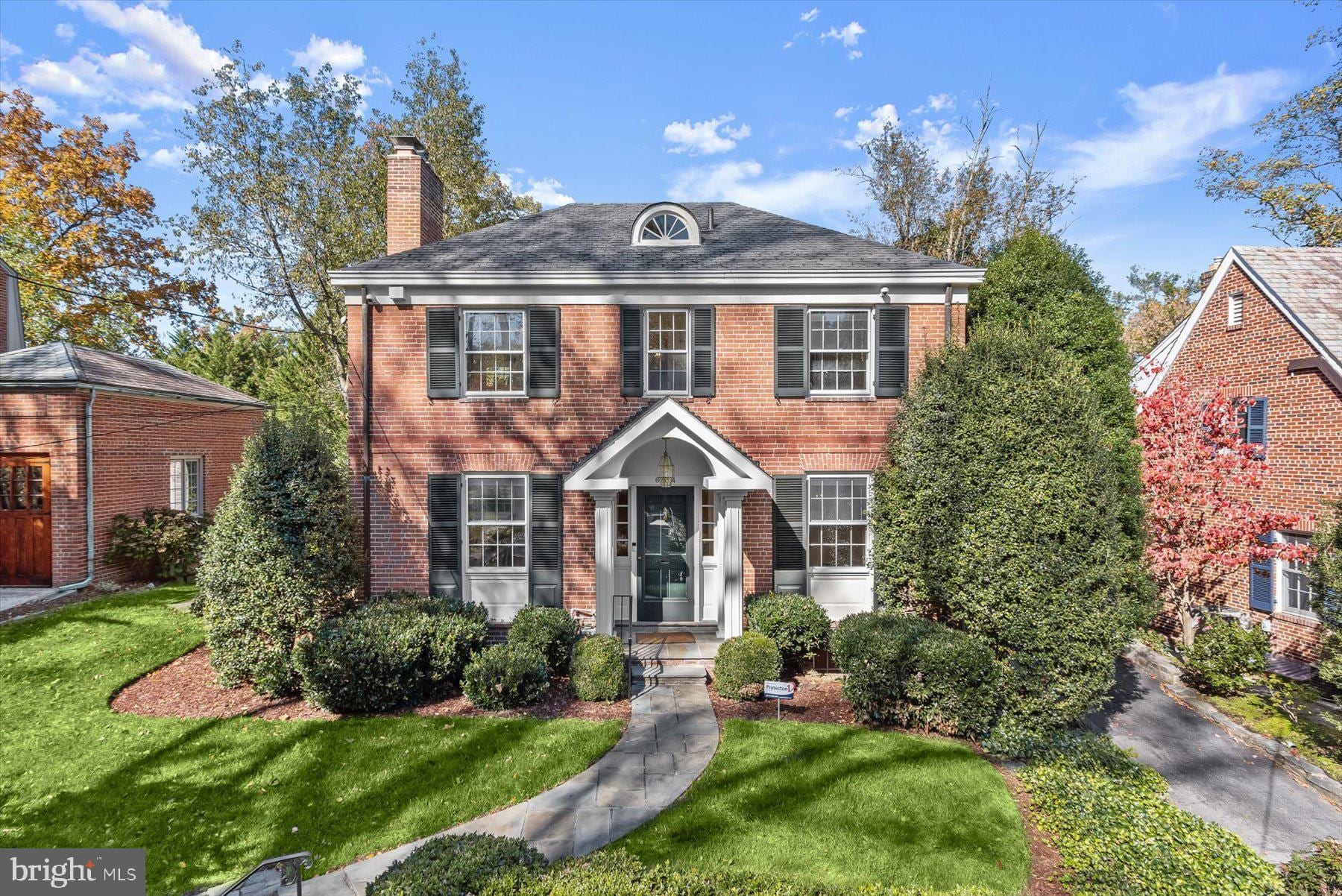
What counts as a luxury home in Washington DC?
Price alone doesn't settle the question in a market this layered. For practical purposes, three bands describe how DC's upper market actually behaves:
Entry luxury, roughly $1.5M–$3M. Well-appointed townhouses in Georgetown, Capitol Hill, Dupont Circle, and the Logan/14th Street corridor; renovated interwar homes in Chevy Chase DC, Cleveland Park, and American University Park; and full-floor condominiums in the Ritz-Carlton Residences, The Westlight, and comparable buildings. Buyers at this band are typically dual-income professionals, senior federal appointees, or late-career move-ups.
Mid-luxury, roughly $3M–$6M. Architect-designed single-family homes in Spring Valley, Wesley Heights, Kalorama Heights, and Forest Hills. Significant Cleveland Park and Cathedral Heights properties. The dominant transaction type is a renovated detached home on a lot of 7,000 to 12,000 square feet with four to six bedrooms, a finished lower level, and off-street parking. Buyers skew toward executive relocators, senior partners at AmLaw 100 firms, returning diplomatic-posted families, and generational-wealth principals.
Trophy luxury, $6M and above. Large estates in Kalorama, Spring Valley, and the Massachusetts Avenue Heights corridor. Historic properties in Georgetown's upper reaches. Significant Foxhall Road estates. Buyers at this band are frequently represented by family offices and often transact fully off-market. Dollar volume at the top band is concentrated in a very small number of annual sales — in a typical year, the City of Washington closes fewer than two dozen single-family sales above $6M.
The boundary moves with the market. In cycles when inventory tightens and interest rates compress, the $1.8M threshold starts to behave like the old $2.2M threshold. Washington Fine Properties and the other DC luxury brokerages treat anything above roughly $1.5M as part of the luxury inventory for data and marketing purposes; buyers should think of the lower threshold as a soft one.
The most useful definition for a buyer isn't a dollar figure at all. It is: the price band at which representation, discretion, and off-market access start to matter more than the search tools on the public portals. For most of DC, that threshold sits somewhere around $2M.
Which neighborhoods have the most luxury home sales?
DC's luxury market is one of the most geographically concentrated in the country. Roughly three-quarters of single-family sales above $3M in a given year close in eight neighborhoods — all of them in upper Northwest. For a buyer orienting themselves, these are the ones to know:
Kalorama — the diplomatic quarter. Large early-20th-century homes on deep lots, embassy row immediately adjacent, exceptionally low turnover.
Spring Valley — architect-designed detached homes on the city's largest lots; the DC neighborhood that reads most like a top-tier Westchester or Montgomery County suburb while still sitting inside the District boundary.
Wesley Heights — mid-20th-century stone-and-brick homes immediately south of American University; strong value relative to Spring Valley per square foot.
Cleveland Park — historic district overlay, significant Queen Anne and Colonial Revival stock, walkable to Connecticut Avenue retail.
Foxhall Village — compact English-Village-planned pocket of upper Northwest; strong cohesion, limited inventory.
Cathedral Heights — Washington National Cathedral adjacent; a mix of significant single-family homes and the Westchester condominiums.
Georgetown (upper) — historic rowhouses north of R Street and the significant freestanding Georgetown estates near Dumbarton Oaks; see her Georgetown vs. Chevy Chase decision guide for how these compare to the Maryland side.
Berkley / Palisades — upper Northwest, directly north of the Potomac, including the 4531 Dexter Street NW area where private-exclusive sales periodically surface.
The Maryland and Virginia communities immediately adjacent — Chevy Chase MD, Bethesda, McLean, Great Falls — form the regional luxury market alongside the DC neighborhoods. A buyer at $3M–$8M typically evaluates DC-side and MD-side inventory together rather than restricting to a single jurisdiction. Her Bethesda market posts and the best-neighborhoods umbrella cover the cross-jurisdiction comparison in detail.
Where the luxury inventory is not: Southeast, the eastern half of Northeast, Shaw, Bloomingdale, and most of the H-Street corridor remain primarily sub-$1.5M markets as of this writing. Some of the largest trophy homes in the District are in Massachusetts Avenue Heights and along Foxhall Road; both of those are small enough to effectively function as subsets of Kalorama and Spring Valley for search purposes.
How does the DC luxury market differ from New York, Los Angeles, or Miami?
Four structural differences change how a buyer should approach a DC luxury transaction:
1. It is quieter. DC's wealth is heavily institutional — government, law, lobbying, finance adjacent to the policy apparatus, foundations, universities, major medical. That profile favors discretion. Open-house activity for a $5M home in Spring Valley is a fraction of what the same price point generates in a comparable Westchester or Pacific Palisades neighborhood. A meaningful share of listings above $3M never hit a signboard, never hit a print ad, and in many cases never hit the MLS at all — they move through private exclusive channels between brokerages.
2. Inventory is tightly constrained by lot supply. DC proper has very little undeveloped land in the luxury neighborhoods. Spring Valley, Kalorama, Wesley Heights, and the historic districts are fully built out and have strong preservation overlays. Teardown-and-rebuild is possible in parts of Spring Valley and the Palisades but is rare elsewhere. The practical consequence: the same twenty or thirty genuinely trophy properties trade in rotation over multi-year cycles, and a buyer who wants to be in the running for one of them needs to be known to the brokerages that represent them.
3. Price-per-square-foot is lower, but transaction frequency is lower too. A Georgetown rowhouse at $1,400/sqft sits well below a comparable Manhattan West Village property. A Spring Valley detached at $900/sqft sits well below a comparable Brentwood property. But the number of options available at any given moment is smaller, and the median days-on-market at the top band can be deceptively short — because the house was quietly shown to a shortlist before it ever hit the MLS and often goes under contract in the first week.
4. The jurisdictional overlay is three-state. DC, Maryland, and Virginia each have different tax treatment, different closing cost structures, different disclosure requirements, and different inspection conventions. A buyer comparing a $4M Chevy Chase DC home to a $4M Chevy Chase MD home is comparing two materially different transactions — not two listings in the same market. DC's recordation and transfer tax structure, MD's documentary stamp tax, and VA's grantor tax all meaningfully affect net cost and should be modeled before an offer rather than discovered at the closing table.
The practical implication for a serious buyer: start the search earlier than you would in a listing-portal-driven market, and expect to spend meaningful time with your agent before you see the first property.
What should buyers expect in a $2M–$10M+ DC transaction?
The mechanics differ from the mid-market transaction in several ways that matter:
Representation is normal, not optional
Nearly every serious buyer at this band is represented by a dedicated buyer's agent. Unrepresented buyers at $3M+ raise eyebrows and reduce access to off-market inventory, because the listing broker's co-op commission structure assumes the buyer brings an agent. A buyer who shows up unrepresented is sometimes asked to sign a disclosed-dual-agency acknowledgment; most sophisticated buyers avoid that structure.
The inspection is more consequential and more collaborative
A luxury DC inspection typically takes four to six hours (not the two to three a standard transaction runs) and often includes specialist sub-inspections: structural engineer for pre-1940 masonry, HVAC specialist for homes with multiple zoned systems, mold specialist for homes that have been vacant, sewer camera for anything with old cast iron laterals, and a radon test as a matter of course in DC. Her inspection conversation guide walks through how sellers at this band typically respond to inspection requests.
Appraisals matter less, but when they fail they fail dramatically
At cash transactions and large-down-payment mortgage transactions, the appraisal is often a formality — the home has comparable sales that support the price. But in a thin-comparable scenario (a trophy home with no true comps in the last 24 months), an appraisal gap can derail a mortgage-contingent deal. Experienced DC luxury buyers often negotiate an appraisal-gap clause up front with an explicit dollar ceiling.
The condo/co-op resale process is distinctive
DC's older cooperative buildings (Westchester, The Towers, Watergate East, Harbour Square) have extensive board approval requirements — financial packages, reference letters, in-person interviews — that extend the contract-to-close timeline by 30 to 60 days. Condominium resale packages are statutorily required and include the budget, bylaws, rules, and reserve study; her DC condo resale package buyer checklist covers what to extract from the package before contingency release.
Timeline
A typical DC luxury transaction runs 45 to 75 days from contract to close — longer for cooperatives, longer for anything requiring HPRB (Historic Preservation Review Board) or Old Georgetown Board review of exterior plans the buyer wants to execute after closing.
What are private exclusive and off-market luxury listings in DC?
A private exclusive (sometimes called "office exclusive," "pocket listing," "whisper listing," or "pre-market") is a property that is actively for sale but is not listed on the MLS, not advertised publicly, and not accessible via the consumer-facing real estate portals. The seller has retained a listing broker; the broker markets the property only through their own network, typically to a shortlist of brokerages and their buyers.
Three reasons sellers at this band choose private exclusive:
Discretion. Public figures, senior executives, families with security concerns, or sellers transitioning through a life event (divorce, estate, relocation) often do not want a signboard or a Zillow page.
Price discovery. For an unusual property with no close comps, a seller may want to test interest at a given price before committing to a public listing with a price history that follows them if they reduce.
Time control. Some sellers want to be ready to transact if the right buyer appears, but not under the time pressure a public listing creates.
For a buyer, the practical implication is that the public search tools do not show the full inventory. A buyer who only looks at Zillow, Realtor.com, or Compass's public site is systematically missing a share of the market — and the share they are missing is disproportionately weighted toward the top band, because that is where private exclusives cluster.
Access to private exclusive inventory is gained through relationships with the brokerages that handle it. Washington Fine Properties maintains an active private-placement roster; the current roster includes 4531 Dexter Street NW, 145 Hesketh Street in Chevy Chase MD, and 4323 Hawthorne Street NW, each at different price bands. Her longer piece on off-market DC luxury sales explains how these move between brokerages.
A buyer who wants to see off-market inventory needs to be registered with a brokerage that participates in the private placement network, be clear about their price band and criteria, and be prepared to move quickly when the right property surfaces.
How do luxury buyers typically finance a Washington DC home?
Three financing paths cover the majority of DC luxury transactions:
All-cash. A meaningful share of DC luxury transactions above $3M close all-cash — either because the buyer has liquidity to deploy, or because they intend to put a mortgage on the property after closing to compete with cash offers on the front end. All-cash buyers should expect a 7- to 14-day close timeline and should still conduct the full inspection, title, and survey work a mortgage transaction requires. Not conducting due diligence because the deal is cash is a mistake.
Jumbo mortgage. DC's conforming loan limit for 2026 is $806,500 (and $1,209,750 in the higher-cost areas of the DC metro, per FHFA). Any DC luxury transaction above those thresholds requires a jumbo loan. Jumbo pricing is typically competitive with or slightly better than conforming rates at the high end, because jumbo borrowers are better-credit and lower-default. Common structures include 30-year fixed, 10/1 and 7/1 ARMs for buyers who expect to transact again within the lock period, and interest-only ARMs for cash-flow management. Private banks (JP Morgan, Goldman Sachs Private, First Republic successor institutions, PNC Private Bank, City National) typically offer the sharpest pricing at $2M+ in exchange for assets-under-management commitments.
Securities-backed line of credit. A buyer with significant brokerage holdings can borrow against them (typically at SOFR + 1.5% to 3%) to purchase all-cash and then refinance into a long-term mortgage at leisure. The structure wins the transaction on cash terms but keeps the buyer's capital invested.
Foreign national financing. Buyers without U.S. tax history — returning expats, foreign-posted diplomats transitioning out of embassy housing, foreign principal buyers — face a narrower lender set. A handful of DC and New York lenders offer foreign-national jumbo programs with 30% to 40% down, and most private banks will underwrite against international assets with the right relationship. The foreign-national path is slower (45- to 60-day closes are typical) and should be initiated before serious house-hunting, not after.
For financing specifics, the current federal conforming loan limits are published at the FHFA conforming loan limits page; confirm the current year's DC figure before setting a budget.
What are the tax implications of buying a luxury home across DC, MD, and VA?
The three jurisdictions tax real estate transactions and ownership differently, and the differences are large enough to affect buy-side decisions.
Item | District of Columbia | Maryland (Montgomery Co.) | Virginia (Fairfax Co.) |
|---|---|---|---|
Recordation / transfer tax at purchase | 1.45% of price (buyer); plus 1.45% transfer tax (seller) — effectively 2.9% split on resale | 1.0% state transfer + 0.5%–1.0% county recordation, split by custom | 0.33% state grantor (seller) + small recordation |
Annual real property tax rate (primary residence, approx) | $0.85 per $100 assessed (Class 1) | ~$0.94 per $100 (Montgomery County total, approx) | ~$1.11 per $100 (Fairfax County 2025, approx) |
Homestead deduction | $90,100 off assessed value (primary residence, filed) | $0 state; county caps assessment-growth at ~10%/yr | Varies; Fairfax has elderly/disabled exemption |
Mansion tax threshold | None at District level | None at state; some counties layer | None at state level |
Capital gains treatment at sale | DC follows federal; no additional DC capital-gains surcharge | MD follows federal; MD income tax on gain if resident | VA follows federal; VA income tax on gain if resident |
Numbers above are 2025–2026 approximate; confirm current rates with the DC Office of Tax and Revenue, Maryland Department of Assessments and Taxation, and the relevant Virginia county assessor before closing.
Two practical implications for a buyer modeling total cost:
DC's transfer and recordation tax is higher at purchase than the surrounding jurisdictions. A $4M DC home carries roughly $58,000 in recordation tax paid by the buyer at closing, where the same $4M home in Fairfax County carries closer to $13,000 in grantor tax (paid by the seller) plus small recordation. Model the cash-at-closing accordingly.
DC's annual property tax rate is lower than MD and VA, which partially offsets the higher transaction tax over a long hold period. For a buyer planning to own for ten-plus years, the all-in cost of DC ownership often comes in competitive with the suburban jurisdictions even after the higher transfer tax.
A full closing-cost model should include recordation, transfer tax, title insurance (including the enhanced policy for high-value homes), survey if required, HOA/condo/co-op transfer fees, and the buyer's share of the annual property tax prorated to closing. Her buyer closing cost guide walks through the DC-side calculation in detail.
What role does a luxury real estate agent play that a general agent doesn't?
The functional difference between a general agent and a luxury-specialist agent at the $2M+ band shows up in five places:
1. Access to off-market inventory. A luxury specialist is in the daily conversation among the brokerages that handle private exclusives. A general agent is not. If the inventory a buyer wants is 30%–40% off-market, 30%–40% of the market is effectively invisible without a specialist relationship.
2. Comparable analysis in thin-comp markets. A trophy home in Kalorama may have no true comparables in the last 24 months. Pricing it requires judgment about which lesser comps apply at what adjustment — a judgment formed by having transacted in that submarket repeatedly. Her DC comparable evidence offer framework is the long version of how this is done.
3. Network of specialists. Senior real estate lawyers, forensic structural engineers, pre-1940 masonry contractors, HPRB-experienced architects, discreet moving companies, insurance brokers who understand the high-value homeowners market. A luxury specialist's Rolodex compresses the time a buyer spends assembling the team.
4. Discretion. A buyer whose transaction is high-profile — public figure, senior appointee, well-known family — needs an agent who has handled high-profile transactions before and who understands that discretion is not a courtesy but a structural requirement.
5. Post-close relationship. The luxury agent-client relationship typically extends beyond the transaction into long-term advisory: when to refinance, when to put a line of credit on the equity, when to add or remove the property from an estate plan, who to call if the roof fails. For families who transact every seven to ten years, the agent is a long-term relationship, not a transaction counterparty.
A buyer who expects to be in DC for a decade or more should treat the choice of agent as a long-term retainer decision, not a one-transaction search.
FAQ
What is considered a luxury home in Washington DC? In practice, any single-family house, attached rowhouse, or full-floor condominium priced above roughly $2 million, with the "trophy" band beginning around $6 million and running through $20 million-plus for the largest estates. The functional threshold is the price band at which off-market access and specialist representation start to matter more than public portal searches.
Which DC neighborhoods have the most luxury home sales? Kalorama, Spring Valley, Wesley Heights, Cleveland Park, Georgetown (upper), Foxhall Village, Cathedral Heights, and Berkley / Palisades account for the large majority of single-family sales above $3M in a typical year. The adjacent Maryland and Virginia communities — Chevy Chase MD, Bethesda, McLean, and Great Falls — form the regional luxury market alongside the DC neighborhoods.
What percentage of DC luxury homes sell off-market? A meaningful share of properties above $3M trade through private exclusive channels before reaching the MLS. Exact percentages vary year to year and are not publicly reported because the transactions by definition are not public. Any buyer serious at $3M+ should expect to engage with off-market inventory through a brokerage that participates in the private placement network.
What is the conforming loan limit in Washington DC for 2026? The 2026 conforming loan limit for the DC metro high-cost areas is $1,209,750 per the Federal Housing Finance Agency. Any transaction above that threshold requires a jumbo mortgage. Confirm the current year's figure at the FHFA conforming loan limits page before setting a budget.
How much is the DC recordation and transfer tax on a luxury home? The combined DC recordation and transfer tax is 2.9% of the purchase price — 1.45% paid by the buyer at recordation and 1.45% paid by the seller as transfer tax. On a $4 million home, that is approximately $58,000 in buyer-side recordation tax at closing. Confirm current rates with the DC Office of Tax and Revenue.
How long does a DC luxury home transaction take from contract to close? Most DC luxury transactions close in 45 to 75 days. Transactions involving older cooperative buildings extend the timeline 30 to 60 days for board approval. All-cash transactions can close in as little as 7 to 14 days.
Do I need a buyer's agent to purchase a luxury home in Washington DC? Not legally, but nearly every serious buyer at this band is represented. Unrepresented buyers reduce their access to off-market inventory because the private placement network is organized around brokerage relationships. The listing broker's co-op commission structure also assumes the buyer brings an agent.
What is the difference between a DC private exclusive and a pocket listing? Functionally the same: a property actively for sale but not listed on the MLS. The terminology varies by brokerage. Washington Fine Properties uses "private exclusive" for properties marketed within a defined network under a written listing agreement.
How does the DC luxury market differ from the Bethesda or Chevy Chase MD market? DC and the Maryland luxury suburbs are tightly linked, and buyers at $3M–$8M typically evaluate both jurisdictions together. The main structural differences are the tax treatment at purchase and the annual property tax rate — DC has higher transfer tax at purchase and lower annual rate; the MD suburbs are the reverse. Architecture, lot size, and school access also differ meaningfully by submarket.
Working with a luxury specialist
Whether a DC luxury transaction is a first move into the market, a return to Washington after a diplomatic posting, or a long-held family property finally changing hands, the common thread is that the right representation changes what inventory is accessible and what price is defensible.
If you are evaluating DC luxury inventory and want to see the current private placement roster alongside the public market, the Washington Fine Properties private placements for Liz Lavette Shorb are published at /properties. For a direct conversation about search criteria, timing, or representation, visit /contact-us.
More context on specific submarkets: Kalorama · Spring Valley · Cleveland Park · Wesley Heights · Foxhall Village · Cathedral Heights · the brokerage story.