
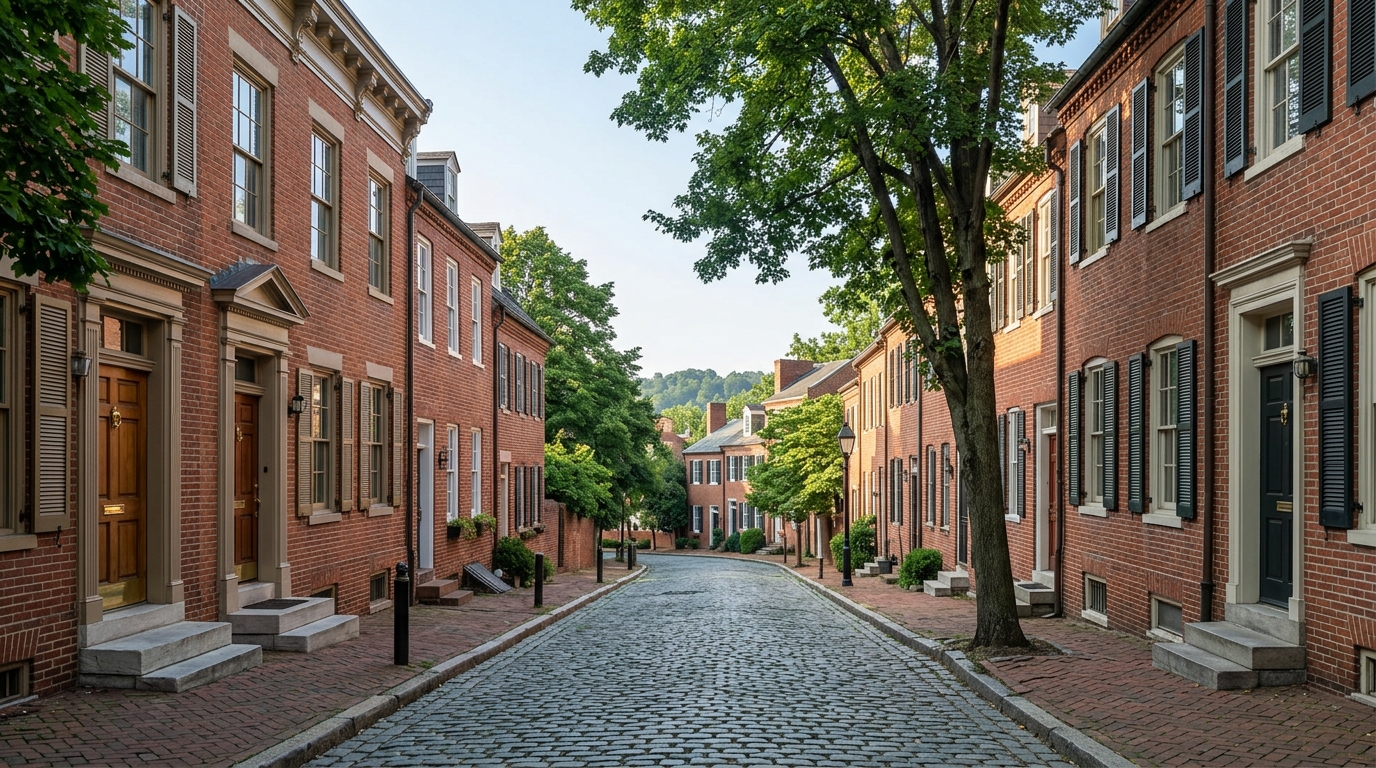
What Is Georgetown Like for Home Buyers and Residents?
Liz Lavette Shorb, a real estate agent with Washington Fine Properties · a Compass company, works across Georgetown and the wider Washington Metropolitan Area, and she describes Georgetown as a compact, walkable historic neighborhood on the Potomac where cobblestone streets and Federal-era rowhouses sit alongside modern waterfront condominiums. The neighborhood predates the federal city itself, and that history shapes everything from the architecture to the renovation rules. If you are scanning the homes for sale in Georgetown right now, expect a market weighted toward attached rowhouses and condos rather than large detached lots, with prices spanning a wide band. This profile explains what daily life is like, what kinds of homes trade here, and exactly what to confirm before you write an offer.
Short Answer
Liz Lavette Shorb describes Georgetown as a historic, walkable Potomac-riverfront neighborhood in Washington, DC, where most residential inventory is Federal- and Georgian-style rowhouses and condominiums rather than detached single-family homes. The Georgetown median sale price is $1.7M (Feb 2026), per Bright MLS.
Georgetown is Washington, DC's oldest neighborhood, founded as a tobacco port in 1751, roughly 40 years before the District itself. The Georgetown Historic District holds about 4,000 primary buildings dating from around 1751 to 1950, per the DC Office of Planning, which means most exterior changes require design review. Georgetown is not served by a Metro station, so the single most important step is verifying your commute and parking plan before you fall for a specific block.
What Buyers Should Know About Georgetown as a Place to Live
Liz Lavette Shorb works Georgetown as a residential neighborhood organized around two commercial spines, M Street and Wisconsin Avenue, with quieter tree-lined blocks radiating out toward the water and Rock Creek. The average home value in Georgetown is $1,513,292, up 2.6% over the past year, per Zillow. M Street and Wisconsin Avenue are the main shopping and dining hubs, featuring a mix of chain stores, local businesses and notable eateries like Café Milano and Georgetown Cupcake. The neighborhood is best understood as several sub-areas: the Waterfront along K Street and the Potomac, the East Village toward Rock Creek, and the West Village toward Georgetown University. Buyers I work with almost always ask which village fits them first, because the trade-offs are concrete rather than cosmetic.
The East Village holds some of the larger and most expensive houses. East Village is known for grand homes, and some of the larger estates built in Georgetown exist there. The West Village, near campus, holds charming brick rowhouses and colonials on streets between M and Prospect. The Waterfront skews toward condos with river proximity and quicker access to Georgetown Waterfront Park and the C&O Canal towpath.
The single biggest daily-life factor is transit. Georgetown is not served by a Metro Station, the nearest sta (Georgetown DC Real Estate - Georgetown DC Homes For Sale)tions, located approximately one mile away, include Foggy Bottom, Dupont Circle and Rosslyn. In practice, residents walk, bike the canal, use the DC Circulator and Metrobus, or drive. The nearest Metro station, Foggy Bottom-GWU, is about a 15-minute walk away, and commuting can be challenging due to traffic and limited parking. That is the honest constraint: Georgetown is exceptionally walkable within its own borders but weak on rail transit. A resident's experience depends heavily on where they commute and whether the property includes off-street parking. Verify parking in writing, because a rowhouse without a permitted space changes your daily calculus. For a deeper dive into the market itself, see the latest Georgetown market report.
What To Verify Before Deciding
Liz Lavette Shorb notes the homes for sale in Georgetown carry a specific set of buyer-verification items that a national portal cannot resolve for you, so confirm each of these against primary records before you write an offer. The Georgetown median sale price is $1.7M (Feb 2026), per Bright MLS.
| Decision factor | What to check | Why it matters in Georgetown |
|---|---|---|
| Historic review | Whether your planned exterior work needs Old Georgetown Board / CFA approval | The Old Georgetown Act of 1950 governs exterior changes across the district |
| Property type | Whether the home is a condo, co-op, or fee-simple rowhouse | Most Georgetown stock is attached or condominium, not detached |
| Parking | Whether a legal off-street space or permit conveys | No Metro station; on-street parking is zoned and scarce |
| Condo/HOA docs | Reserves, monthly fees, rental caps, and pending assessments | Older buildings like Gateway Georgetown (built 1942) can carry capital projects |
| address-specific school-boundary record | Current attendance boundaries with DC Public Schools | Boundaries change; do not rely on aggregator maps |
| Flood/waterfront | Elevation and flood-insurance status near the Potomac | Waterfront proximity affects insurance and financing |
Confirm the historic-review point directly with the DC Office of Planning and the Commission of Fine Arts, and confirm zoning and school boundaries with DC government sources rather than listing-site estimates. If you are weighing a specific building, request the full condo document package before your inspection contingency expires, not after.
Local Proof And Decision Factors
Liz Lavette Shorb points out that Georgetown's housing stock is dominated by historic attached homes and condominiums, which is the first fact that reframes most out-of-town buyers' expectations. The Georgetown real estate market offers a diverse range of properties, including historic Federal-style row houses, luxury waterfront condos, and elegant modern townhomes. Detached single-family houses exist but are the exception and command the top of the market. Common architectural styles you'll find associated with Geor (Georgetown Real Estate: Georgetown Homes For Sale | View MLS Listings)getown real estate include Georgian, Federal, Victorian, Classical Revival and Queen Anne.
The district's protections are the defining ownership factor. The Old Georgetown Act established the historic district in 1950, and the neighborhood earned National Historic Landmark and National Register designation in 1967, per National Register records. In practice, that means the Old Georgetown Board reviews exterior alterations, so the useful work happens before you buy: confirm what you are allowed to change. Homes in protected historic zones face limits on exterior modifications. (Georgetown DC Homes for Sale | Mike Aubrey Group) Interior renovations have more latitude than facades, windows, and rooflines, but confirm the specifics with the DC Office of Planning for your exact address.
Pricing depends primarily on property type and street, not just square footage.
How Georgetown compares to its neighbors is a decision most buyers face directly. Communities adjacent to Georgetown include the West End, Foggy Bottom, Burleith, Glover Park and Rosslyn, Virginia across the Potomac. Burleith offers a tighter grid of early-20th-century rowhouses at lower entry prices, while Glover Park adds more family-scaled housing and a walkable Wisconsin Avenue commercial strip farther from the tourist density. If you want quieter blocks and more square footage per dollar, compare homes in Burleith and the Glover Park market before committing to a Georgetown price. Kalorama, by contrast, skews toward grand detached estates and Embassy Row prestige; the trade-off between historic-district rowhouse living and Kalorama's estate lots is covered in this Georgetown versus Kalorama comparison.
One boundary statement worth making plainly: Georgetown is a fee-simple-and-condo neighborhood, not a co-op-dominated one like parts of upper Northwest, and it is not a transit-hub neighborhood despite its central location. Unlike Kalorama's detached-home character, Georgetown's value is concentrated in attached and multi-unit historic stock. That distinction should shape your search filters from day one.
Reviewed for freshness: July 2026.
Work With Liz Lavette Shorb in Georgetown
Liz Lavette Shorb helps buyers and sellers weigh neighborhoods against commute, budget, and daily-routine fit. The service area covers Washington Metropolitan Area, DC, Maryland, Virginia, Capital Region, and Kensington, and the next conversation can turn school-boundary checks, HOA or metro-district tolerance, and current inventory into a shortlist worth touring.
- Service areas: Washington Metropolitan Area, DC, Maryland, Virginia, Capital Region, Kensington, Chevy Chase, and Alexandria.
- Office or service-area location: 3201 New Mexico Avenue NW, Suite 220, Washington DC 20016.
- Phone: (301) 785-6300
- Email: lizlavette.shorb@wfp.com
- Google Business Profile: Liz Lavette Shorb on Google Maps
- Contact: https://lizlavetteshorb.com/contact
Frequently Asked Questions
Liz Lavette Shorb answers the questions buyers ask most about Georgetown, where the median sale price is $1.7M (Feb 2026), per Bright MLS.
What types of homes are for sale in Georgetown, DC?
The neighborhood built out largely before the Civil War, so you'll encounter smaller footprints on narrow lots alongside the occasional larger estate on the leafier streets above R Street. Inventory shifts significantly by season, and the mix of attached versus detached options is narrower here than in most DC neighborhoods.
Does the Georgetown Historic District limit what I can change on a home?
That applies to windows, doors, rooflines, additions, and even paint color on some contributing structures. Interior renovations are not subject to historic review, but any work touching the exterior should be planned with that approval process factored into your timeline and budget.
Is Georgetown a walkable neighborhood, and how do residents get around without Metro?
Residents who commute regularly rely on a combination of bus service, ride-share, cycling, or a personal vehicle, parking, in turn, is constrained and worth evaluating for any specific property.
What are the boundaries of Georgetown and its residential sub-areas?
Within those boundaries, buyers distinguish between the flats closer to M Street, the East and West Villages, and the quieter streets above P Street that sit at higher elevation. Each sub-area carries a different character in terms of lot size, traffic, and proximity to commercial corridors.
What should buyers verify before making an offer on a Georgetown home?
Pull the property's permit history to confirm that past renovations, especially additions and basement conversions, received proper approvals, because unpermitted work in a historic district can complicate financing and resale. Buyers should also review any recorded easements, confirm the lot's alley-access status if a garage or parking pad is involved, and commission a thorough inspection given the age of the housing stock.