
Homes for Sale in Kalorama: What Buyers Should Know Before Choosing
Homes for sale in Kalorama fall into four concrete types: historic detached mansions in Sheridan-Kalorama (often $5 million to $18 million-plus), renovated rowhouses (roughly $2 million to $5 million and about 4,000 square feet), luxury condos and co-ops in named "Best Addresses" buildings like The Brighton and The Dresden, and a thin supply of converted multi-unit properties. Kalorama is not one market; it is two historic districts, Kalorama Triangle and Sheridan-Kalorama, each moving on its own price and timeline. Liz Lavette Shorb, a residential agent with Washington Fine Properties · a Compass company, counsels buyers here often. Before you commit to a block, confirm the exact historic district and review authority tied to that address, because that single fact shapes what you can renovate and how long approvals take.
Short Answer
Liz Lavette Shorb counsels buyers that Kalorama is a luxury Northwest DC neighborhood made of two historic districts, Kalorama Triangle and Sheridan-Kalorama, bounded by Rock Creek Park, Massachusetts Avenue, Florida Avenue, Connecticut Avenue, Columbia Road, and Calvert Street. Home values here span a wide range, with grand Sheridan-Kalorama estates running into the multiple millions; the historic Kalorama home of D.C. socialite Esther Coopersmith was listed at $18.5 million (source). Housing includes historic mansions, renovated rowhouses, and luxury condos and co-ops such as The Brighton and The Dresden, and much of the neighborhood falls under historic preservation review. The single most important step: confirm which historic district and review board governs the exact property, because that determines what exterior work is permitted and how long approvals take.
Homes for Sale in Kalorama: The Four Types Buyers Will Find
Liz Lavette Shorb identifies four broad housing types among homes for sale in Kalorama: historic detached mansions, renovated rowhouses, luxury condominiums and cooperatives in "Best Addresses" buildings, and a small supply of infill or converted multi-unit properties. New construction is rare, so supply growth stays modest and off-market sales are more common here than in most DC neighborhoods.
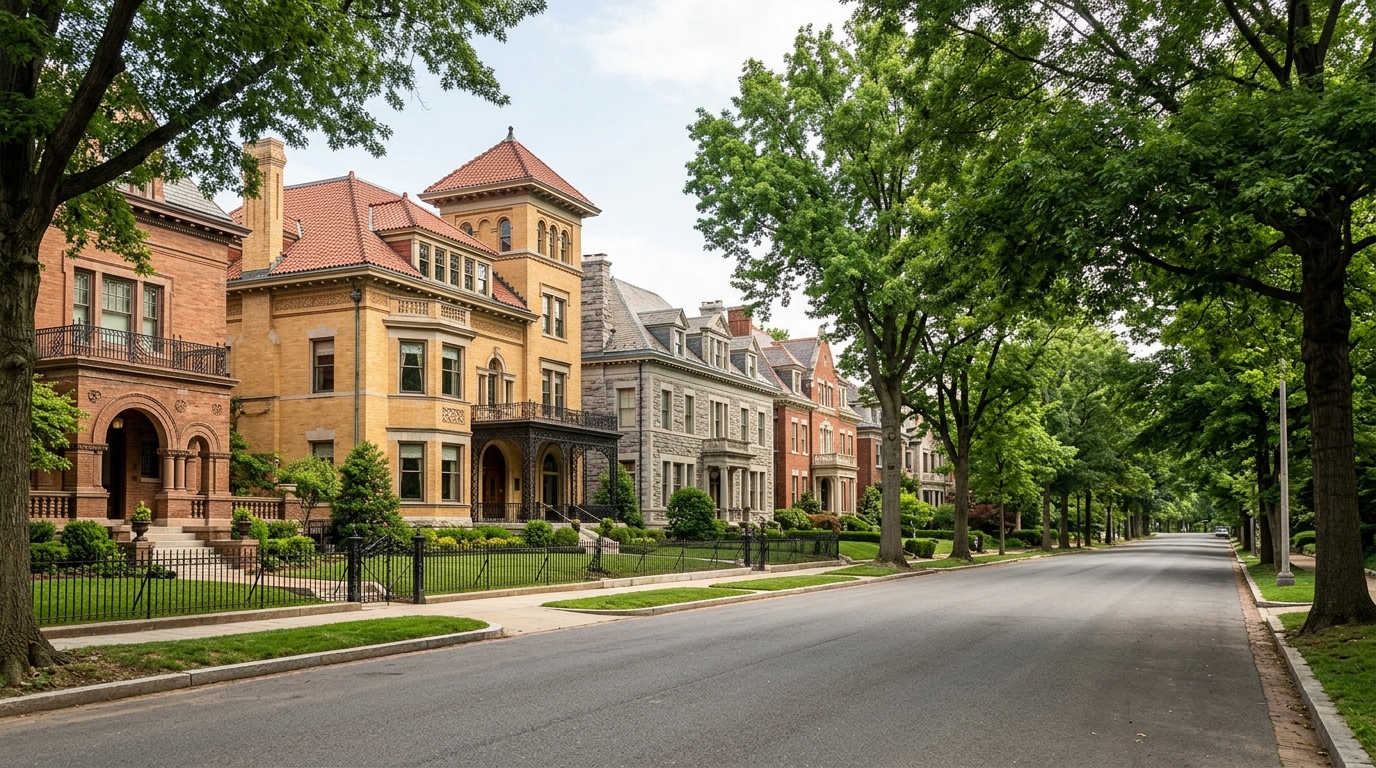
The detached homes are the top tier. In Sheridan-Kalorama, detached homes have Federal, Georgian, or Colonial Revival architecture with five to seven bedrooms. Many of these mansions date to the early 1900s through the 1920s, when bridges and streetcar lines drove a development boom, and estate-tier listings run into the multiple millions.
Rowhouses occupy the middle of the market and are frequently renovated. A representative recent Sheridan-Kalorama listing was a Georgian Colonial with two-car parking offering four bedrooms, 4.5 bathrooms, and roughly 4,000 square feet across three levels. These homes appeal to owner-occupants and, when configured as multi-unit holdings, to investors.
Condos and co-ops span the widest budget. Kalorama's historic apartment buildings, several converted to condominiums, include named "Best Addresses" like The Brighton and The Dresden. Unlike the mansions, these buildings come with concierge service, parking, and on-site security, and they carry monthly fees plus, for co-ops, board approval requirements that a single-family purchase does not. That distinction is not cosmetic: a co-op purchase means buying shares in a corporation and clearing a board, not taking direct title. If a condo or co-op fits your plan, review the building's financials and rules before the offer, and read more about buying a condo in Northwest DC to understand the fee and reserve questions that matter most.
Kalorama at a Glance: Districts, Boundaries, and Micro-Markets
Liz Lavette Shorb approaches Kalorama as a collection of micro-markets rather than one uniform neighborhood. The name means "beautiful view" in Greek, and the area sits on a hill just above Dupont Circle in the Northwest quadrant of Washington, DC.
Kalorama is bounded by Rock Creek Park, Massachusetts Avenue, Florida Avenue, Connecticut Avenue, Columbia Road, and Calvert Street, and it splits into two enclaves: Kalorama Triangle and Sheridan-Kalorama. Housing ranges from grand estates and historic rowhouses to "Best Addresses" condo and co-op buildings. Prices vary sharply by property type and sub-area, so a renovated condo near Kalorama Triangle will not track the same pricing or days-on-market as a detached mansion in Sheridan-Kalorama. Because inventory is thin and off-market sales are common here, the practical first move is to define your search polygon by district and property type, then pull rolling MLS metrics for that exact segment rather than relying on a single neighborhood-wide median. If you want a market read tied to your actual price band and property type, that requires a live MLS/IDX pull as of July 2026, which is where a local agent earns their keep.
Kalorama Triangle vs. Sheridan-Kalorama: How the Two Districts Differ
Liz Lavette Shorb points to Kalorama Triangle and Sheridan-Kalorama as the two historic districts inside Kalorama, and the difference matters for both lifestyle and price. Kalorama Triangle sits closer to Dupont Circle and Adams Morgan and carries more mid- and high-rise apartment and condo stock, while Sheridan-Kalorama holds the mansion corridor and larger lots.
Kalorama Triangle is the smaller, denser district. It was listed on the DC Inventory of Historic Sites and the National Register of Historic Places in 1987, so exterior review applies here just as it does in the mansion blocks.
Sheridan-Kalorama is the diplomatic heart. It is home to more than 50 embassies and ambassadorial residences per neighborhood documentation, and its western edge along Massachusetts Avenue is the stretch locally known as Embassy Row. The price gap between the two is real. Sheridan-Kalorama is a historic district that holds an elegant mix of embassies, chanceries, churches, and private schools, with properties ranging from single-family mansions to stately condo and apartment buildings, and recent listing activity there has skewed toward the estate tier.
| District | Character | Typical inventory | Historic review |
|---|---|---|---|
| Kalorama Triangle | Denser, walkable, near Dupont and Adams Morgan | Mid- and high-rise apartments and condos | Listed on DC Inventory and National Register (1987); exterior review applies |
| Sheridan-Kalorama | Quiet, diplomatic, larger lots | Federal/Georgian/Colonial Revival mansions, stately co-ops | Designated historic district; HPO approval for most exterior changes |
The practical takeaway: if you want walkable density and a broader condo range, look at the Triangle first. If privacy, larger lots, and diplomatic quiet drive your search, Sheridan-Kalorama is the target. To settle which district a specific home sits in, check the MLS neighborhood boundary against the DC historic district map before you write an offer, because the answer changes both your renovation rules and your comparable sales set. You can go deeper on the neighborhood feel in this guide to what Kalorama is like for buyers and residents.
What To Verify Before Buying a Home in Kalorama
Liz Lavette Shorb recommends this checklist to compare Kalorama homes against one another and against nearby neighborhoods. Each line is specific to how this market actually trades.
| Decision factor | What to check | Why it matters in Kalorama |
|---|---|---|
| Which district | MLS boundary vs. DC historic district map | Kalorama Triangle and Sheridan-Kalorama have different price tiers and comparable sets |
| Historic review authority | Whether HPO/HPRB governs the exact address | Exterior changes visible from public space require approval |
| Property type | Mansion, rowhouse, condo, or co-op | Co-ops require board approval and share ownership, not direct title |
| Building financials | Condo/co-op reserves, monthly fees, rules | High-amenity buildings carry meaningful carrying costs |
| Off-market supply | Broker intelligence and public records | Discreet sales are common; portal inventory understates true availability |
| Current pricing | Live MLS/IDX pull as of July 2026 | Small sample sizes mean one large sale can skew a monthly median |
| Days on market | Segment-specific DOM by type | Days-on-market vary widely by property type and price band |
Historic District Rules and Documents to Verify by Address
Kalorama properties in both districts fall under historic preservation review, which means most exterior changes visible from public space must be approved before work begins. This is a designated-historic-district rule, not an HOA rule, and it is administered by the District's Historic Preservation Office (HPO) with significant cases decided by the Historic Preservation Review Board (HPRB).
The scope is concrete. Sheridan-Kalorama is a designated historic district, meaning D.C.'s Historic Preservation Office must approve most exterior changes made to a property. Interior renovations that do not touch the exterior sit outside this process, but additions, window replacements, roof changes visible from the street, and facade alterations do not.
This is where timeline planning matters. Preservation review adds weeks to months depending on the project's complexity, so a buyer planning a major renovation should build that into the offer and settlement calendar rather than discovering it afterward. Before you write an offer on a home you intend to change, request any prior HPO or HPRB approvals for that address, confirm whether the work you want is likely reviewable, and ask a preservation-savvy architect to flag the risk items. For a fuller walk through the documents and approvals, see this resource on buying a historic home in Washington, DC. The rule of thumb: verify the review authority by address, because a block in the Triangle and a block in Sheridan-Kalorama can carry different practical constraints.
How Kalorama Compares to Georgetown, Dupont Circle, and Woodley Park
Liz Lavette Shorb notes that Kalorama differs from its Northwest DC neighbors chiefly in tone: it is quieter, more residential, and more diplomatic than Georgetown or Dupont Circle, with grand mansions, larger lots, and fewer tourist flows. Buyers who choose Kalorama over those neighborhoods are usually prioritizing privacy and a lower-traffic setting.
| Neighborhood | Tone and setting | Typical inventory | Review authority |
|---|---|---|---|
| Kalorama | Quiet, diplomatic, residential | Mansions, rowhouses, "Best Addresses" condos/co-ops | HPO / HPRB (historic districts) |
| Georgetown | Waterfront, retail, tourism | Narrow historic houses, boutique condos; avg. value $1,513,292 | Old Georgetown Board / Commission of Fine Arts |
| Dupont Circle | Dense, mixed-use, nightlife | Broad middle-to-upper range, smaller lots | Dupont Circle historic district |
| Woodley Park / Cleveland Park | Park access, family-oriented | Townhouses, garden-style condos | Local historic districts |
Against Dupont Circle, the contrast is density and energy. Dupont